6/7 83km
We left Fontaine Ct Ocean Grove at about 14.30 picked up food then fuel at our favourite APCO servo in Geelong South then headed up the Midland Hwy to camp at my site at Morrisons at about 16.45. I had a few rural birds by dark as we had a few sandwiches, having had a lovely roast lunch with Colin and Lynne before we set off. The creek here is noisy with Brown Tree Frogs and Common Eastern Froglets, so it could be a creaky night.
7/7 214km
The frogs were very considerate and mostly went quiet after 21.00. This morning though I woke up at about 5.30 and couldn’t stop coughing until I got up. I wasn’t feeling the best at all as I went on my walk in -2C with a light frost on the grass. I didn’t add much of interest. We headed into Ballarat and to a doctors who said it was a heavy viral load, so sent me down to the local Chemist Wharehouse to get some drugs that might help me. Just around the corner were some speed bumps as we headed off, the second one unhitched the trailer and it dragged along the ground, the crossed chains not doing their job, as did the person hitching the trailer yesterday, not locking it. It took me a while to get the nose high enough to get it back on the hitch with the weight of the draw bar being too heavy to lift manually. We managed to get it back on with no damage done, and headed up to Bursons Auto Parts to pick up some differential oil. The seal to the wheel is leaking a bit again, not happy about that, it was only a few years ago I had to fix the same problem and they should do a lot more than 150000km. It was lunch at Pioneer park Ballarat where there weren’t many birds at all. Next stop was The Dam Mt Beckworth. The dam was low with only a few birds calling in the area, and no feeding. Lundys Waterholes is just a farm dam with tall trees along the roadside, again just a few birds calling in the area. By the time we got to Avoca River Coonoer it was camping time in the fading winter light.
8/7 208km
There was water in the river but no flow with no waterbirds in evidence, only 12sp here which is pretty poor since there’s good woodland along the riverside. Wooroonook Lakeside rest area on the other hand was teeming with waterfowl, mostly Coots, about 4000 of them with a few ducks lurking in low numbers and some Australian Grebes. Jeffcott North lake was dry with only a Red-capped Robin to brighten the place up a bit in the gloomy winter showers that persisted. Granite Flat School site had 60 Red-rumped Parrots which is an unusually large number. Swamp Rd Chirrup had some water in the dam with some Wood Ducks and a more normal flock of 5 Red-rumped Parrots. Chirrup Rd Corack east had a good sized flock of White-winged Choughs in the woodland. We had lunch at Tyrell Ck SE of Dumosa where the Red-rumped Parrots were down to a pair. Walsh Rd Arnold Rd Culgoa had a flock of 22 Eastern Rosellas which is high but not unprecedented. Lake Tyrell south only had 3sp all around the visitor building, nothing out by the lakeside as the cold wind ripped through me. The day has been cold and windy with occasional showers making the birding uncomfortable, so in many cases I was lucky to find any birds at all. We camped at Lake Tyrell north in the fading light again.


9/7 251km
There are a few tracks to walk around here so I mapped them as I strolled around finding some White-winged Choughs that look like they’re starting the nesting procedure, going as far as chasing a Magpie away from the developing nest. 12Sp here in the sparse woodland. We managed to get the trailer in to Bonzewing open area over the sand dunes without having to lower the tyre pressure, but the day was still cold and windy so didn’t get much, only 4sp. Nowingi Trk Hattah NP which is the well known spot for Mallee Emu-wren disappointed with only a few Yellow-plumed Honeyeaters and a Grey Shrike-thrush found. We mapped the track around to the highway where my site 5km south of Nowingi lies at the end of Mallee Trk, with only 3sp here. From there it was in to Mildura to shop and fill up the tank and out to Mallee Cliffs NP where we are volunteering for 2 weeks at the AWC reserve inside the park. We arrived to find no one about so we put up the roof and went to sleep.

Some photos from Mallee Cliffs National Park


24/7 334km
Our time at Mallee Cliffs has come to an end. We spent our time helping the staff with odd jobs such as track clearing, filling up the tanks at the watering points inside the feral proof fence and the all important job of checking the integrity of the fence. I was able at one point to get out to my site at Mallee Cliffs NP SE and found no birds there which is always disappointing in a national park. We set off this morning after bidding our fellow volunteer Natasha farewell and headed back to the Sturt Hwy and headed east. I had no sites on the road to Balranald so it was a straight drive down the highway. We topped up the fuel tank at the BP south of the town, it being much cheaper than those in town, then headed up the Ivanhoe Rd. It was a pleasant sunny cold day with my jacket not coming off all day. Five Mile Station north of Balranald set the tone for the day with only 3sp with a flyby well overhead of a Wedge-tailed Eagle. SE of Geraki Tank was the best site, despite there being no water in the tank. There is good Saltbush here with a Redthroat calling , another Wedge-tailed Eagle overhead and a pair of Nankeen Kestrels hunting. It was a walk out to Box Ck tank which is 800m south of the road, I wasn’t well rewarded for my effort with some Black-faced Woodswallows and a Singing Honeyeater that escorted me in to the tank and then back out and a pair of Willy Wagtails that weren’t happy to see me. Oakdene Station Timber Reserve had some Striped Honeyeaters. Then three sites in lake beds with poor vegetation. Lake north of Hatfield had no birds, as did Dolmreve Well lake. Clare Freshwater Rd junction had a lone Australian Raven. We camped at Grid SE Clairbank Station. It looks like they’re building a fence across the track here, so there soon won’t be a camping spot here. We found an open area not far up the track to spend the night, getting Spiny-cheeked Honeyeater and Striped Honeyeater before dark.
25/7 309km
The day dawned a gloomy windy day with the promise of rain that arrived at about 9.30 but was very light, and lasted until after lunch when it was 7C, with the wind chill it certainly felt much colder doing my surveys. The overnight survey ended with only 8sp. The habitat looks okay here at first glance with good woodland and lots of Bluebush around too, but there is but stubble as ground cover. The problem of course is over grazing. Once you have poor ground cover you loose a whole suite of birds reptiles and insects which then impacts those that remain. Our farmers though seem to care little about that with a heavy population of goats throughout the region. Things were no better at 50km SW of Ivanhoe with only a lone Magpie found. Things improved from there though with a stop at Willandra Ck SW of Ivanhoe adding Reedwarbler, Black-fronted Doterrel and White-winged Fairywren despite the damage done to the creek edge by stock. Through Ivanhoe and onto the Cobar Rd to Ticehurst Tank which had lots of parrots, Welcome Swallows and Tree Martins with water in the tank. Morningside Station tank also had water in it with 7sp in the surrounds. Timber reserve SW Cobar grid had 3sp of thornbill feeding. Yallock Station dam was dry with only 3sp in the surrounds. 135km SW of Cobar had a White-plumed Honeyeater which have probably been around, but have been silent. This one sat up in a tree and gave the warning that I was around to the other 4sp in the area. Paddington TR is fenced off, but by now the rain had stopped and the birds were active in pairs with 2 Jacky Winters, 2 Southern Whitefaces 2 Red-rumped Parrots, 2 Brown Trecreepers and then I found 4 Red-capped Robins to ruin the narrative. At Paddington SF north the birds were even more active adding Mistletoebird, Restless Flycatcher, Hooded Robin and Grey Shrike-thrush. At Floodway timber reserve we found Little Woodswallow and Speckled Warbler. So birding on cold wet windy days can be productive, especially if things moderate. We camped at Old Reservoir Cobar and had 6sp by dark. With the threat of more rain we had an early dinner.


26/7 311km
The rain arrived last night. There was enough to make driving dirt roads here out of the question. Ended the survey with 17sp, which probably isn’t bad considering the conditions which were cold and windy. We headed east along the Barrier Hwy. First stop was Meryula Rail where I found some Splendid Fairywens, none in breeding plumage yet. Next was Canbelago SF where there were some Grey-crowned Babblers and some easterly Noisy Miners. Hermidale Rail only had some Australian Ravens and Red-rumped Parrots in this backwater of a settlement. At Miandetta SF there were 4sp of Thornbills feeding and some Silvereye. One utterly confused me by singing like a warbler. If I hadn’t actually watched as it warbled away I would have kept on looking for a different bird. At Gerar Station Rd things went bad for us. I had missed the road, but rather than backing back with the trailer I parked on the steep sided verge, big mistake. The survey had White-necked Heron and White-winged Fairywren calling from the saltbush. When I tried to move off though I found that the verge was too muddy and my wheels just span. So we unhitched the trailer and got the car onto the road, but when I backed back on an angle to rehitch, the tow bar was too high with the jockey wheel at its extent, so I tried pulling the trailer around but that broke the jockey wheel and the trailer nose collapsed. It’s way too heavy to lift, so we unloaded it. That’s when the local farmer turned up and got a high lift jack and a lever to stop the trailer’s nose from fading down hill. When two other passers by stopped to help we had enough muscle to rehitch the trailer. Lost time, about 1½ hrs. We got ourselves under way and stopped at Macquarie Marsh NR 1 where there was a Horsefield’s Bronze Cuckoo and Variegated/Purple-backed Fairywrens, again none in breeding plumage. We camped at Macquarie River Carinda where after dark there were some Eastern Sign Bearing Frogs calling. I had 11sp on the bird list in the still cold and windy conditions that had persisted all day as the clouds scudded by without dropping more than a drop or two of rain.

27/7 419km
More rain overnight, but the dawn brought sunshine which activated the birds, so I got 22sp. I was worried about the muddy climb from the river flat out onto the road, so I got Bev to check for traffic, put in the diff locks and roared up the little slope onto the road, disengaged and off we went leaving a trail of mud on the road. Gungalman Rd north of Carinda was busy with 13sp in the 20min survey in the sparse grassy woodland, finding Brolga as new. Barwon River west of Walgett had Rufous Songlark and Sacred Kingfisher. Walgett town pool area had 55 noisy Red-tailed Black Cockatoos and a reedwarbler in the pond just to the west, which was where most of the cockies were hanging around too. Barwon River Collarenebri had a pelican in the river. We drove a short way down a dirt road off the Gwydir Hwy to Browns Ck Wally Bunyan Bridge to find 16sp over lunch. There was a bitumen patch either side of the bridge which with careful manoeuvring enabled me to turn around and drive back up the muddy road. Another layer of mud on the trailer and car. Halls Ck south of Moree was flooded with a Golden-headed Cisticola in the long grasses and Eastern Sign Bearing Frog calling from a pond created by the flooding creek. On eastward to Warialda Rail which had a large flock of 38 Common Mynas, I can imaging some people going tch tch, but nothing seems to be slowing down this invasive species. We camped at Warialda Rest Area where there were two colonies of Common Eastern Froglets, one in the grasses by the rest area, the other down by the creek.


28/7 378km
Another cold windy cloudy day beckoned us at dawn. There is good forest to the south of the rest area and in it found White-throated Gerygone, Little Friarbird and Olive-backed Oriole amongst others, ending the survey with 26sp, getting there. North up the Yetman Rd is Agincourt Rd south of Coultai which is open farmland with a few scattered trees, here I found a flock of 22 Common Mynas, more than all the other birds put together. We headed through Ashford and onto the Bruxner Hwy, winding slowly though the hills past Tenterfield. We stopped at Bruxner Hwy rest area 1 where it was too windy still, so only 2 birds up in the hills despite good forest, getting the first Lewin’s Honeyeater though. At Drake we tried to do a bit of mapping of a dirt road, but ended up at locked gates on what was supposed to be a through road. I can’t believe how many locked gates we find! So we had to retrace our steps back to the Bruxner Hwy and went up Clarence way to Bonalbo south for not many species by the roadside. We tracked in to Peacock Ck camp Richmond Range NP where we got Eastern Whipbird, Satin Bowerbird, Noisy Pitta and King Parrot before dark.

29/7 195km
Despite there being a good looking frog pond next to the campground and a running creek, there were no frogs calling last night. There were also no night birds, haven’t heard a single one this trip. On my morning stroll I found Logrunner, Large-billed Scrubwren and Bev had a Yellow-throated Scrubwren around the car whilst I was out. We left at 8.00 and it took us until 11.20 to get to Nightcap NP 1 going via Kiogle, Nimbin and Dunoon. The roads were in poor shape with lots of potholes, quite a few roadworks shoring up the hillsides after landslips, and of course being a heavy lumbering vehicle, it was a slow drive along the winding steep roads. I was rewarded for my efforts by getting a leech down by the river. I did add Brown Gerygone and Wonga Pigeon. We then went to Byron Bay and parked as close as we could get to the lighthouse without paying for parking. It took an hour and twenty minutes to walk out to the most easterly spot on mainland Australia at Cape Byron, and back. I hope Ollie appreciates all the effort we put in to get here. On the way finding Bush Turkey, Little Wattlebird, Little Shrike-thrush with some Crested Terns and a Pied Cormorant off the coast. Tyagarah NR had some Yellow-tailed Black Cockatoos, and Waterlily Park Ocean Shores had Figbird. We camped at Yelgun Rest Stop with quite a few other campers, though no tents, they’re not allowed here. I had Noisy Friarbird, Fan-tailed Cuckoo and 9 others by dark.


30/7 371km
Had 15sp for the survey and headed off at 7.10 to Scott’s Island Reserve Tumblegum, where I got more Large-billed Scrubwren and a Hobby Falcon. Womin Bay had Blue-faced Honeyeaters and Noisy Friarbirds with a bit of flowering going on amongst some grevillias. They have rules for dogs on leads here along the track to the beach and south along the beach. In the short time I was there I found two in violation, and yes they were told so. Ukerbah NR Tweed Heads had Mangrove Gerygones and a White-bellied Sea Eagle. Terranora Broadwater north shore had some expectant Pelicans with an oyster and crab industry here. We tanked up the fuel at a Metro servo at 167.9cpl. Picked up food at The Pines Elanora and headed off into the hills. Up Mt Tamborine. For me it was 2km of 1st gear labouring up the hill. We had lunch at Leyey Lookout Rd where it was too windy, so didn’t get much. The northern approach was a longer, gentler slope down, then over to Spring lake Springfield Lakes for some human tolerant species. From there it was express to Bowenville Reserve Wainui west of Toowoomba. By express I mean no stops, not quickly, as we didn’t arrive until well after dark. It didn’t help with going through Toowoomba because the ring road around the city has a toll on it. I despise tolls.


31/7 452km
Ended the survey with 24sp including a single Double-barred Finch, which has been missing up until now. Riders Rd Dalby had some Pale-headed Rosellas. We then took the back roads to get to Gil Weir where we had lunch. It’s a cold cloudy day and the area around the weir is mostly Calitris Pine forest, even though it’s a native I never seem to find much in them. From here it was west along the Warrego Hwy with sites on or near the highway. JD Ck Waituna had a flock of 16 Noisy Miners, Yuleba SF Channing had a lone Blue-faced Honeyeater calling. Inglebrook SF had a few Weebills being their onomatapoeic selves. Freemans Rd east of Roma had Yellow-rumped Thornbills, but they scarpered as soon as I got near them. The last time I was here one came up to touching distance from me trying to figure out what I was doing sitting in amongst the bushes here. We topped up the tanks at the Liberty servo in Roma as fuel gets steadily more expensive as we head west, it was 172.5cpl for super deisel. Muckadilla Ck had another large flock of Common Mynas, 21 this time. We camped at Neil Turner Weir Mitchell not long before dark with probably 150 other campers strung out along the grassy area here with all the campfires, generators and dogs that I expected.

1/8 341km
I woke predawn to the screech of a Barn Owl, shortly after that a drawn out descending dooo call started, I racked my brain but couldn’t think of what it might be, as I listened I noticed that it was in sync with my breathing, so I took a deep breath and it stopped, started breathing again and it started up again, it was my own breath out that I was fooled by. Dawn came not much later with the usual kookaburras, magpies, Pied Butcherbirds and the like and along with that came this call again, so I took another breath and it kept calling, so I wasn’t a fool after all. But I was still left with the problem of what this call was. There are good reed beds here by the weir so I’m thinking a reed dweller of some sort that I don’t know the call of. Then for some reason I managed to hear the full call, and it went something like this, cockadoodledoo. Yup a local farmyard rooster, probably over a kilometre away, well that’s my excuse. At least I’d figured out what it was. 34Sp for the site eventually, not counting the rooster of course because it’s not wild. On westward to Mungallala cemetery which didn’t have much in the way of birds, just lots of short epitaphs of loss on old headstones. Morven Recreation Reserve had water in the billabong with 37 Wood Ducks and a pair of Common Mynas. This is a campground with a donation, it has hot showers so we took the opportunity to pay the usual $5ea to get clean. Sommariva rest stop was lunch with the first Diamond Doves. Into Charleville where Bev did the shopping whilst I updated some places of interest in town for Hema. Then we went to do the clothes washing at the laundramat. It was after 15.00 when we left town and headed to Ward River Meecha at the old river bridge, getting 19sp in the 20min. There is camping here but we decided to keep going. At 67m mast Wanko I found Hooded Robin and a flock of 18 Apostlebirds belying their name, I can’t remember the last time I saw a flock of 12 of them. Cooladdi rail was done too late, but it had rained a few minutes before I got there and that had activated the birds including 3 Black Honeyeaters and a Crested Bellbird, then I found a pair of Pink (Major Mitchell’s) Cockatoos. We camped at 14 mile waterhole north of Cheepie just on dark with Brolga and Pallid Cuckoo calling.


2/8 459km
19sp for the site, finding Olive-backed Oriole, 10 Budgerigars, Grey-crowned Babblers and in the water hole a lone Grey Teal. The day started out gloomy with some light drizzle but cleared soon to a mostly sunny cool day. My jacket came off for the first time in days. On westward to Winbin Bore which had some Cassias in flower with a pair of Black Honeyeaters. Lake Houdraman Quilpie had a compliant Sacred Kingfisher and an invisible Little Friarbird, could not find it despite it chortling away. Topped up the tank in town and on we went. Diamantina Development Rd floodway was busy around the small remnant of a pool with both Diamond and Peaceful Doves and with a few eucalypts in flower Brown, White-fronted and White-plumed Honeyeaters with 18 White-browed Woodswallows, and Bev found a Red-capped Robin. Dam 115km west of Quilpie had lots of flowers in bloom attracting White-winged Triller, Crimson Chat and some Zebra Finches. By the waterhole was a pair of Spinifex Pigeons. Gully 84km west of Windorah wasn’t looking good with only a Grey Butcherbird calling in the mainly Mulga woodland, but it was stony country, so what are two sought after species that prefer stony county in this area? The first one I spotted as it headed away from me scuttling along the ground from bush to bush. A Chestnut-breasted Quail-thrush. I whipped out my camera to see if I could manage a shot but it was too good for me, I’d just given up the chase when a group of Hall’s Babblers streamed by me and off they went too. Cliffs Ck Clifton Station only had a small puddle left but I got a female Collared Sparrowhawk that was sort of obliging, not going too far away and letting me approach close enough for a shot. Cooper Ck Diamantina Development Rd only had pools in this smaller branch, the main branch further west had more water. At my site I got a Brown Goshawk along with the usual under bridge nesting colony of Fairy Martins. Carranya ephemeral wetland only had a small pool with 50 Black Kites swirling around and nothing much of interest. We camped at Mornay Ck east with a bit of time before sunset, so we took the time to rearrange the trailer to take some weight off the nose and put it in the back of the trailer.


3/8 374km
We had a big flock of 30 Black-faced Cuckoo-shrikes come through, probably on migration, since this is usually a rather solitary bird. Also added Red-backed Kingfisher in the rather brisk 2C sunny morning. It warmed up to not only jacket off but jumper off too. First stop was Ferrars Ck west channel where the Fairy Martins were nesting under the eaves of the water monitoring stand, there being no bridge here. We’re now seeing Budgerigars at most surveys, mostly in small flocks of 10 or so. We took the Davenport Rd to get us into Diamantina NP, but we first had to go through cattle stations. Palparara T junction had water in a dam and the nearby creek finding both Variegated/Purple-backed and White-winged Fairywrens and a White-necked Heron in the dam. Grassy plain SE Diamantina NP has nothing above ankle high, mostly stunted Saltbush and grasses, but I managed to find a Brown Songlark which specialises in this habitat. Davenport Ck was dry and cattle ravaged with only 4sp. We crossed into the national park and the first stop was at Diamantina River east channel. There weren’t heaps of birds, though certainly more than the last stop, but what was most evident was that the ground cover was intact, walking through thigh high grasses rather than bare ground. We had a late lunch at Hunter Gorge campsite where there were 30 pelicans in the survey parameters and lots more outside. It was rather late in the afternoon when we started the Warracoota Circuit Drive, it was already 15.20 when we got to Lake Constance where we managed to find a Black-fronted Doterrel. Warracoota Waterhole had a Rainbow Bee-eater, not sure whether it over-wintered here or is an early arrival, but it’s the first one we’ve seen. Green Tank had 10sp with 3 Brown Songlarks in the grasses above the tank. We camped at Spring Ck Coorabulka Rd not long before dark with a pair of Brolgas calling nearby.


4/8 258km
There was another flock of Black-faced Cuckoo-shrikes heading south again this morning, this time 42 of them. Apart from that there wasn’t much around. The dawn chorus consisted of a lone Australian Raven doing a solo impression of being bored. Back to the Boulia Rd and westward to Spring Ck Boulia Shire border where a lone Grey Shrike-thrush was harmonising with itself for most of the survey. Found a Rufous Whistler which has been light on. Springvale Rd junction east of Boulia had some White-winged Trillers and a Red-backed Kingfisher. At Burke River Boulia there was a big pool with Plumed (Intermediate) and Great Egret, some pelicans feeding grumpily and a lone Little Black Cormorant. We filled up the tanks and the jerry cans at the IOR card only deisel only servo, much cheaper than the roadhouse across the road. I then managed to log myself out of our mapping app and couldn’t get back in, so I rang up our coordinator at Hema who guided us back in, but with 507 downloads to do it took too long so we gave up and headed off down the Donohue Hwy. One of the things we can map is floodways, it’s astonishing just how many floodways there are on our roads, most of the 507 downloads were floodways. Small mast west of Boulia had a Crested Bellbird. Dam west of Boulia has a solar array pumping water into a huge tank, but it was overflowing creating a small wetland which the Zebra Finches and Diamond Doves were using. There was roadkill here which had attracted a pair of Wedge-tailed Eagles, a Whistling Kite and 4 Little Crows. I tried getting close enough to get a good shot of the eagle on the kill but it flew off before I could get a good shot and the crows were immediately on to it. We stopped at 15.00 at Georgina River west of Boulia which had some large pools of old water, getting 17sp before dark.


5/8 288km
Overnight there was an Owlet Nightjar calling, the first one for the trip, I usually get this species about every second night, so it’s been very quiet. The Brolga pair were still around in the morning and I managed to get sort of close enough for a shot without frightening them off, unlike the flock of Hardhead, Grey Teal and Black Duck that were on the river, as soon as I poked my head around a tree by the bridge most of them were off. Some Hardhead lingered long enough for me to get an establishing shot before they were off too. On westward we went to Glenormiston Station west of Boulia where Bev flushed a Little Button-quail. There were a few patches of dirt road which were in good condition, but it’s mostly bitumen now to the border. Small creek west of Boulia was dry but had 18 Zebra Finches. Old Linda Downs Station grid had Crimson Chat. Tobermoray Station floodway was lunch with Hooded Robin. Heartbreak Bore has a solar array permanently pumping water into a huge tank which at least at this time of year overflows creating a wetland which had a pair of Grey Teal and 20 Zebra Finches with a Brown Falcon managing to get on a survey. We see them regularly along with Nankeen Kestrels, but they rarely seem to like my survey sites. The area around the tank was devoid of ground cover for hundreds of metres and strewn with cattle dung. Awful place (check out the habitat photo on the page). 63m mast Marqua Station only had a handful of birds. We camped at Arthur River Plenty Hwy. It’s dry but it’s a roosting place for the Galahs and Little Corellas that are likely to be getting their water from cattle troughs. 13Sp by dark including the first Red-browed Pardalote. So far the road in the Northern Territory has been mostly rough gravel which has slowed me down. We’ve had a few warm sunny days now, today there were a few Bearded Dragons out sunning themselves in the middle of the road, I managed to miss them all, but it’s inevitable that some will get run over by people who drive so fast on these roads. One of the down sides of warm sunny days is flies, and over the last few days they’ve been increasing in numbers to become quite annoying today.


6/8 263km
Just on dark last night a Boobook Owl called and just before bed a Tawny Frogmouth called so two more usually common species have been detected for the first time on this trip. It was whilst having breakfast and having a general look over the vehicle that I noticed that the awning on the trailer was missing, it was held on by rivets and somewhere along the way it’s popped all of them and fallen off. One more black mark for Kings equipment, there’s quite a long list now. We set forth a little bit lighter than expected to Bonya Ck Plenty Hwy for 11sp including 8 Crimson Chats in the flowery meadow above the creek. Plenty River was predictably dry with a few Cockatiels and Little Corellas. Mast 63m Plenty Hwy had 8sp. Mount Eaglebeak Rd junction only had a lone Singing Honeyeater trying it’s best to sing but only sounding to me like chubbut… chubbut… One of the big problems out here is Buffel Grass, and here it was prevelant, with hardly any other ground cover. Being an introduced species our native species tend not to use it, so with it being just about the only ground cover it has the same effect as no ground cover, again losing many species which works its way up the food chain. It was the same at Aturga Ck west of Atitjere where we had lunch with only 4sp. We decided to camp very early at Saltbush Flat Dam which is well off the highway. The sun wasn’t much in evidence today with a cool wind blowing, so the afternoon was spent out of the wind in the lee of the vehicle whilst I counted out the birds at one stage have 3sp of fairywren around me, White-winged, Splendid and Variegated/Purple-backed. None wanted their photo taken though, in fact none of the 24sp I found before dark were interested in posing for me.


7/8 192km
We’re back to no night birds and having such a long time yesterday to find the birds using the area I only added Fairy Martin and a lone Budgerigar to the list. Back to the main road and on west to Mueller Ck west of Gem Tree where I found a Pied Honeyeater. We turned south at Stuart Hwy and stopped at 147km south of Ti Tree, which is out along a fence line. There wasn’t much Buffel Grass here so some native flowers were out in bloom with Pallid Cuckoo and White-fronted Honeyeater as interesting. I’m also managing to get Brown Falcons on a few surveys recently rather than spotting them in between. In to Alice Springs and filled up the tank at the Metro deisel only card only servo, being so much cheaper than all the others. Bev did her shopping whilst I got our permits for the Great Central Road. We decided to camp at the G’Day mate caravan park since they were charging $48 for a powered site. So it was another early day. It was a gloomy day anyway with a few light showrs passing through.


8/8 250km
We were off at 7.50 and south down the Stuart Hwy stopping at rest area south of Alice Springs which had some Zebra Finches making use of the water here. Stuart Hwy 65km south of Alice Springs site had a Red-browed Pardalote. Hugh River Stuart Hwy only had three ordinary species and was a rare site not to have at least one Budgerigar in evidence. 157Km north of Kulgera had some flowering erimophela with both Pied and White-fronted Honeyeaters, 15sp all up in the 20min survey. The last time I was here it was a good birding spot too. Finke River rest area had 14sp despite the river being dry with the first Weebills for a while. We turned west at Ernest Giles Rd and stopped at the Palmer River for lunch. It was dry too with a lot of Buffel Grass and only a spattering of trees along the banks which meant not many birds. We came close to having another catastrophe not far up the road. Yesterday I had swapped the tyres around at the caravan park. I don’t know if I didn’t tighten the nuts up properly or I hadn’t seated the wheel properly, but as I was having my usual glance around the car I noticed a gap between a nut and the rim. Sure enough it was loose, so were three others. So I tightened them up and no damage done. We camped early again at Salt Creek rest area in behind the dunes amongst the Desert Oaks whispering in the cool southerly breeze on a mild sunny day. Only 6sp by dark which included Pink (Major Mitchell’s) Cockatoo. A pair came to a tree nearby and let me get close enough for a shot. They were inspecting a hollow, so I thought they might be looking at nesting here, but they flew off to join the small flock nearby and off they all went. I checked all the wheel nuts again and they’re still tight.


9/8 255km
There was a lonely dawn call of one Magpie carolling away, after dawn it was joined by the Morse Code staccato of a Crested Bellbird which I’m getting on most surveys in the area. Ended the survey with 9sp. Desert Oak isn’t great habitat for birds. Headed south to the Lasseter Hwy then west to Curtin Springs east rest area where I disturbed a pair of Little Buttonquail that exploded from right next to me as I searched the dunes. Both of us are finding interesting flowers to put on to inaturaist to find out what they are. Quarry Tk Lasseter Hwy only had 3sp with a pair of Crested Bellbirds. Sandy Way rest stop only had 12 Zebra Finches using the water supply here. We booked in to the Yalara campground $60 for a non-powered site in a large gravelled area. $76 for entry into the national park for both of us. Uluru sunset car park had another Crested Bellbird. Mala Walk Uluru had 7sp in the hour that it took to stroll the 2km return track to the small waterhole at Kantju Gorge. Around to the other side to the shorter walk in to Kuniya Waterhole for only 3sp. So the birding certainly wasn’t worth the price, but you don’t come here to see the birds do you. We topped up the tank in preparation for our much anticipated and it looks like third time lucky, trip down the Great Central Road to Laverton in WA, then back to the campsite.


10/8 286km
There was no bird survey to do this morning, but it was 8.45 before we set off arriving at the Olgas viewing platform at 9.25 but only finding 8 Crested Pigeons and a pair of Singing Honeyeaters. We got to the Valley of the Winds at 10.00, the carpark was already nearly full so there were a lot of people on the walking trail. It took an hour and forty minutes to get to the second lookout and back, which didn’t do the place justice, but we had a long way to go so it was a hurry. It was cold and sunny when we set off and warm and sunny by the time we got back, so inside my jacket I was sweating some. The only highlight of the walk was hearing an Owlet Nightjar call, unusual to hear them call at this time of day. And so it was that we set off down the Great Central Road. The first stop at 30km west of the Olgas was still in Desert Oak sand dunes and only had Singing Honeyeater and Willy Wagtail. The site at 100km east of the WA border was even more quiet with a lone Singing Honeyeater. Lasseters Cave is by the Hall River which was dry, but the River Redgums had the usual suspects, White-plumed Honeyeaters, Weebill and Striated Pardalote. Docker River Campground was back to Desert Oak and had zero birds. We camped not far over the WA border at Gill Pinnacle Rest Stop. The peak lies about 1km away so isn’t part of the 500m survey. There were however some Eremophelas in flower with both Black and White-fronted Honeyeaters as well as the usual Singing Honeyeaters. Our find of the day was the aptly named Moloch Horridus, it was in the middle of the road and I completely missed seeing it I was so concentrating on finding the best line to take, but Bev spotted it so we turned around and took some photos, then helped it off the road. There isn’t a lot of traffic on the road but we didn’t want to leave it to chance for this very slow moving reptile. At one of our stops Bev noted something hanging down the inside of one of the trailer wheels. It turned out that the electric brake wire was shorn off, so no brake on that side.


11/8 317km
The wind picked up during the night making the zippers rattle and occasionally strong enough to rock Rudolph enough to wake me, so I didn’t sleep well. Ended the survey with 11sp. It was whilst I was cable tying the loose brake wiring on the trailer that I noticed that another shock absorber was done for. This one had destroyed the upper mounting and was trying to bash its way into the floor of the trailer. I decided to take all the shocking shockers off as the trailer doesn’t travel that badly without them. So we headed on SW to mast 8km west of Warakurna which had some Torresian Crows and the usual Singing Honeyeater. At sand dune SW of Warakuna I thought it looked prospective for Striated Grasswren and had one call within a few minutes of getting out of the car. I had a brief view of one, and after the 20min was up Bev used her app to give it a call, it responded but never showed itself, so although there’s likely to be more than one here I had to limit the count to one. Tikelmungulda Waterhole lies about 500m metres from the road, and although the waterhole was a predictable flop being no more than a slight depression and dry, the walk in produced Chestnut-rumped Thornbill and Redthroat. We had lunch at mast NE Warbuton in good looking spinifex country but couldn’t find any grasswrens here, though I did find Red-browed Pardalote, still haven’t seen one for a while now, they’re very elusive little birds. Creek NE of Warburton only had a White-plumed Honeyeater and a pair of Yellow-throated Miners. We camped at stopping bay 20km SW of Warburton in very open grassland with only a few small shrubs. Got only 3sp by dark, but it was a definite possibility that I could have had none.


12/8 277km
We had a thunderstorm pass by us in the early hours, but all we got was a sprinkle, just enough to make us close up the windows on the camper. It’s not very often that an overnight survey yields only 3sp, but I couldn’t find anything else in the morning. The day started cool and windy, quickly becoming sunny and warming up, but staying windy all day. Onwards we went to Winduldarra Rockhole. There is a rocky outcrop here and the hole is in the gully, I could see where animals had dug out the sand underneath a shelf to reveal a wet patch, but no standing water, and not a single bird was detected in the mainly Mulga woodland. At Manunda Rockhole my Hema Navigator had the rockhole about 1km away, so I had a pleasant walk through the woods but could find no rockhole. I found a track so mapped that back to the road where I found the rockhole right next to the road, so I mapped that as well. There is just a hole in the ground here with some rocks around it to stop people driving into it and some metal pieces over the top to stop people falling in to it, but nothing to stop people throwing their rubbish into it. Disrespect. On my walk I found a Hooded Robin which was my bird of the day. At Wahlgu Rockholes we couldn’t find any holes, just a lone Singing Honeyeater. We had lunch at 340km NE of Laverton in good mainly Mulga woodland but apart from the expected Singing Honeyeater I only found a lone Splendid Fairywren. David Garnegie Rd junction again had Singing Honeyeater this time with a lone Spiny-cheeked Honeyeater. We camped at Lake Throssell which has been dry for some time and only had 3sp by dark with Bev’s bird of the day 4 Mulga Parrots. I went for a stroll around the lake bed and into the acacia woodlands and only found a lone White-winged Fairywren and guess what, more Singing Honeyeaters.

13/8 390km
Up with the dawning and found a few species using the woodlands including Hooded Robin, and a pair of Galahs, so it seems there’s water somewhere in the vicinity, just not in the lake. Down the road we went to large white cross which is looking a bit forlorn now. We got Crested Pigeon and Common Bronzewing here, so more water somewhere. 180Km NE of Laverton only had a pair of Crested Pigeons. The Pines Camp NE of Laverton had the first Red-capped Robin for a while. Giles Breakaway Parking Area was birdless and the quarantine bin NE of Laverton only had a pair of Inland Thornbills. So ended our trip down the Great Central Road. The road was generally pretty good with mostly small corrugations, there were only a few spots on the whole road where I had to slow down because it was too rough. I was generally disappointed with the birding, all the sites I looked at had low numbers of birds in what were mostly good looking habitat. The entire region did look dry with little to no flowering happening. We bypassed Laverton and stopped at stopping bay 19km east of Laverton which only had Pied Butcherbird. There was a bit of flowering at floodway east of Leonora with Yellow-rumped Thornbill. We camped at Malcolm Dam which had a good level of water with plenty of waterfowl on it including Shelduck and Musk Duck. I found a few Pied Stilts and was setting up for a shot of them when a Hobby Falcon zoomed in and frightened everything in its path including the stilts. It was nice to see the Hobby though.


14/8 327km
34sp was the final tally for the site adding Yellow-billed Spoonbill and Western Bowerbird amongst others. Into Leonora to do a bit of shopping to get us to Perth and filled up a tank from the BP deisel only, card only depot which isn’t in the main street. We headed north up the Goldfields Hwy, why we’re going away from Perth will become apparent tomorrow some time. I walked down the track at parkbay 30km north of Leonora finding Redthroat and White-browed Babbler. More northwards to Goldfields Hwy Teutonic where there was a Whistling Kite patrolling the highway and Bev found a flock of 20 Zebra Finches. Goldfields Hwy south of Leinster only had a Crested Bellbird and a pair of Splendid Fairywrens. At Leinster we turned west towards Sandstone. At stopping bay west of Leinster there was only a Singing Honeyeater. Stopping bay east of Sandstone looked worse habitat, finding Singing Honeyeater and Crested Bellbird, but then we got Varied Sitella for the first time in quite a while. Floodway east of Sandstone was back to Singing Honeyeater and Crested Bellbird. There has been some rain here recently so it’s looking green for the first time since we left the coast. With the days warming up the flowers have started to come out here. We turned down the Paynes Find Road and drove up to Tabletop along the easy 4wd track, camping at the base of it on the dead end track. Had 9sp by dark which isn’t bad for a dry hillside site in a good mainly acacia woodland. The view from the top is panoramic.


15/8 467km
Finished the survey on a cool crisp sunny morning with 11sp including a Spotted Nightjar heard overnight. Headed on southward towards Paynes Find and stopped at Yuinmery South Rd junction which had a good thicket of shrubs on a dry creekline, in it were Brown Honeyeater and Grey Shrike-thrush. Floodway NE of Paynes Find had another Brown Honeyeater. Finally it was time to get a road mapped as we drove the Narndee-Red Bluff Rd with the paddocks looking more like meadows all carpeted in flowers. Had lunch at 26km north of Paynes Find on the truck filled highway, topped up the tank at Paynes Find then south on the Mouroubra Rd stopping at grid south of Paynes Find and finding a Redthroat and a good sized flock of 6 Chestnut-rumped Thornbills. Grid north of Cleary had another Redthroat then we wound our way along as many unmapped dirt roads as we could to get to Petrudor Rocks to camp. I went for a walk over the uper rock and found some orchids out, but it was too dark to photograph them.


16/8 313km
We both went in search of orchids in the morning finding only 3sp, a lone spider orchid wasn’t open yet, the other two species were photographed. It was 9.20 when we headed off mapping more dirt roads and finding 3 no through roads, two of them weren’t signposted. It’s rather difficult turning the trailer around on a narrow dirt track let me tell you, one of them required me to back it at least 500m back up the track. I don’t know which is worse, coming to a surprise dead end or finding our usual locked gate, either way it’s no fun with a trailer. We had lunch at Lake Ninan which was butcherbird rich then headed in to Perth to finish almost a year of travelling. We are both in need of some rest.


Predictably this would be the last trip for the Kings trailer. It was a poor investment lasting about 3 years. It cost about $17000 and we sold it for $2000 in need of repairs that I wasn’t prepared to put more money into. A reminder that as far I’m concered steer clear of Kings equipment.
Nompsep 31/8/25
Kenji and Sayuri
Separated by war
Found by love
We mourn when we loose a loved one
Who mourns the lonely soldier
Defeated by the night
Their ghost singing Waltzing Matilda
My tears they fall on hardened concrete
Happiness is transitory
Is a soldier’s souls forfeit
No matter who he kills
Is it right for me to be comfy
In this world of wrongs
As it crumbles into dust
Agressive bullies, thugs and tyrants
All the wrong people have power
The colours have faded to black and white
And so we fight
Warring nations
Battling factions
All consuming hate
Outside my garden gate
My hands raised behind the barbwire fence
I pray futilely for peace
But all I see is the the end
The horizons closing in
Blood red clouds in the middle of the day
Distraught woman stares wildly at the camera
Gaunt-eyed child stares blankly into space
It’s broadcast to the world
Not my problem somebody else’s problem
Steady head don’t leave me now
Retarded souls
Emotionally deficient
No heart
Fooling themselves at church
The common no longer has sense
Sleepwalking into the abyss
Not my problem somebody else’s problem
What price indifference
These days of selfish impatience
These days of nationalistic protectionalism
Obesity and diabetes
Traffic jams and stress
Perpetual distress
Self induced mess
Mental illness
Not my problem
Somebody else’s problem
Depleted oceans
Damaged ecosystems
Plasticated planet
Nompsep
Floods in Pakistan
Fires in Spain
Just another category five
Nompsep
Nompsep
Nompsep
If you would like to contribute the well being of this world, our world, your world, an easy and effective way to do it is to join a quality environmental group. There are many spread across the world all plugging away trying to make the world a better place for wildlife. We belong to Birdlife Australia, Bush Heritage, Royal Society for the Protection of Birds (RSPB) and Australian Wildlife Conservancy (AWC). You can donate your time and or money to these and many others knowing that the world will be a slightly better place because of your effort.
Bird list for the trip, 172 surveys done.
- Black Swan Cygnus atratus 1 (0.58%)
- Australian Shelduck Tadorna tadornoides 2 (1.16%)
- Hardhead Aythya australis 2 (1.16%)
- Pacific Black Duck Anas superciliosa 12 (6.98%)
- Grey Teal Anas gracilis 13 (7.56%)
- Musk Duck Biziura lobata 1 (0.58%) (B)
- Australian Wood Duck Chenonetta jubata 10 (5.81%)
- Australian Brush-turkey Alectura lathami 3 (1.74%)
- Australasian Grebe Tachybaptus novaehollandiae 3 (1.74%)
- Spotted Dove Spilopelia chinensis 3 (1.74%)
- Wonga Pigeon Leucosarcia melanoleuca 1 (0.58%)
- Spinifex Pigeon Geophaps plumifera 1 (0.58%)
- Common Bronzewing Phaps chalcoptera 7 (4.07%)
- Crested Pigeon Ocyphaps lophotes 30 (17.44%)
- Diamond Dove Geopelia cuneata 8 (4.65%)
- Peaceful Dove Geopelia placida 11 (6.40%)
- Bar-shouldered Dove Geopelia humeralis 2 (1.16%)
- Brown-capped Emerald-Dove Chalcophaps longirostris 2 (1.16%)
- Horsfield’s Bronze-Cuckoo Chalcites basalis 2 (1.16%)
- Black-eared Cuckoo Chalcites osculans 1 (0.58%)
- Fan-tailed Cuckoo Cacomantis flabelliformis 1 (0.58%)
- Pallid Cuckoo Heteroscenes pallidus 4 (2.33%)
- Tawny Frogmouth Podargus strigoides 1 (0.58%)
- Spotted Nightjar Eurostopodus argus 1 (0.58%)
- Australian Owlet-nightjar Aegotheles cristatus 2 (1.16%)
- Purple Swamphen Porphyrio porphyrio 2 (1.16%)
- Dusky Moorhen Gallinula tenebrosa 2 (1.16%)
- Eurasian Coot Fulica atra 4 (2.33%)
- Brolga Grus rubicunda 5 (2.91%)
- Pied Stilt Himantopus leucocephalus 1 (0.58%)
- Black-fronted Dotterel Elseyornis melanops 5 (2.91%)
- Banded Lapwing Vanellus tricolor 1 (0.58%)
- Masked Lapwing Vanellus miles 9 (5.23%)
- Little Button-quail Turnix velox 2 (1.16%)
- Silver Gull Larus novaehollandiae 5 (2.91%)
- Greater Crested Tern Thalasseus bergii 2 (1.16%)
- Australian Pelican Pelecanus conspicillatus 11 (6.40%)
- White-necked Heron Ardea pacifica 8 (4.65%)
- Great Egret Ardea alba 7 (4.07%)
- Plumed Egret Ardea plumifera 1 (0.58%)
- White-faced Heron Egretta novaehollandiae 3 (1.74%)
- Australian White Ibis Threskiornis moluccus 9 (5.23%)
- Straw-necked Ibis Threskiornis spinicollis 2 (1.16%)
- Yellow-billed Spoonbill Platalea flavipes 1 (0.58%)
- Little Pied Cormorant Microcarbo melanoleucos 3 (1.74%)
- Great Cormorant Phalacrocorax carbo 1 (0.58%)
- Little Black Cormorant Phalacrocorax sulcirostris 4 (2.33%)
- Australasian Darter Anhinga novaehollandiae 6 (3.49%)
- Osprey Pandion haliaetus 1 (0.58%)
- Black-shouldered Kite Elanus axillaris 2 (1.16%)
- Wedge-tailed Eagle Aquila audax 4 (2.33%)
- Brown Goshawk Accipiter fasciatus 2 (1.16%)
- White-bellied Sea-Eagle Haliaeetus leucogaster 1 (0.58%)
- Whistling Kite Haliastur sphenurus 24 (13.95%)
- Black Kite Milvus migrans 8 (4.65%)
- Barn Owl Tyto alba 1 (0.58%)
- Southern Boobook Ninox boobook 1 (0.58%)
- Rainbow Bee-eater Merops ornatus 1 (0.58%)
- Sacred Kingfisher Todiramphus sanctus 2 (1.16%)
- Red-backed Kingfisher Todiramphus pyrrhopygius 5 (2.91%)
- Laughing Kookaburra Dacelo novaeguineae 11 (6.40%)
- Nankeen Kestrel Falco cenchroides 6 (3.49%)
- Australian Hobby Falco longipennis 3 (1.74%)
- Brown Falcon Falco berigora 7 (4.07%)
- Cockatiel Nymphicus hollandicus 9 (5.23%)
- Red-tailed Black-Cockatoo Calyptorhynchus banksii 2 (1.16%)
- Yellow-tailed Black-Cockatoo Zanda funerea 3 (1.74%)
- Galah Eolophus roseicapilla 31 (18.02%)
- Major Mitchell’s Cockatoo Cacatua leadbeateri 2 (1.16%) (B)
- Long-billed Corella Cacatua tenuirostris 3 (1.74%)
- Little Corella Cacatua sanguinea 11 (6.40%)
- Sulphur-crested Cockatoo Cacatua galerita 10 (5.81%)
- Australian King-Parrot Alisterus scapularis 1 (0.58%)
- Red-winged Parrot Aprosmictus erythropterus 2 (1.16%)
- Red-rumped Parrot Psephotus haematonotus 12 (6.98%)
- Bluebonnet Northiella haematogaster 2 (1.16%)
- Mulga Parrot Psephotellus varius 1 (0.58%)
- Crimson Rosella Platycercus elegans 1 (0.58%)
- Pale-headed Rosella Platycercus adscitus 4 (2.33%)
- Eastern Rosella Platycercus eximius 3 (1.74%)
- Australian Ringneck Barnardius zonarius 4 (2.33%)
- Musk Lorikeet Glossopsitta concinna 2 (1.16%)
- Little Lorikeet Glossopsitta pusilla 1 (0.58%)
- Rainbow Lorikeet Trichoglossus moluccanus 9 (5.23%)
- Scaly-breasted Lorikeet Trichoglossus chlorolepidotus 1 (0.58%)
- Budgerigar Melopsittacus undulatus 29 (16.86%) (B)
- Noisy Pitta Pitta versicolor 1 (0.58%)
- Satin Bowerbird Ptilonorhynchus violaceus 1 (0.58%)
- Spotted Bowerbird Chlamydera maculata 1 (0.58%)
- Western Bowerbird Chlamydera guttata 2 (1.16%)
- Brown Treecreeper Climacteris picumnus 7 (4.07%)
- Variegated Fairy-wren Malurus lamberti 11 (6.40%)
- Superb Fairy-wren Malurus cyaneus 7 (4.07%)
- Splendid Fairy-wren Malurus splendens 5 (2.91%)
- White-winged Fairy-wren Malurus leucopterus 9 (5.23%)
- Striated Grasswren Amytornis striatus 1 (0.58%)
- Black Honeyeater Sugomel nigrum 3 (1.74%)
- Striped Honeyeater Plectorhyncha lanceolata 6 (3.49%)
- Noisy Friarbird Philemon corniculatus 3 (1.74%)
- Little Friarbird Philemon citreogularis 3 (1.74%)
- Brown Honeyeater Lichmera indistincta 7 (4.07%)
- White-eared Honeyeater Nesoptilotis leucotis 1 (0.58%)
- Blue-faced Honeyeater Entomyzon cyanotis 5 (2.91%)
- Pied Honeyeater Certhionyx variegatus 3 (1.74%)
- Crimson Chat Epthianura tricolor 3 (1.74%)
- Lewin’s Honeyeater Meliphaga lewinii 7 (4.07%)
- Spiny-cheeked Honeyeater Acanthagenys rufogularis 38 (22.09%)
- Little Wattlebird Anthochaera chrysoptera 3 (1.74%)
- Red Wattlebird Anthochaera carunculata 3 (1.74%)
- Singing Honeyeater Gavicalis virescens 49 (28.49%)
- Yellow-plumed Honeyeater Ptilotula ornata 1 (0.58%)
- White-plumed Honeyeater Ptilotula penicillata 46 (26.74%)
- White-fronted Honeyeater Purnella albifrons 3 (1.74%)
- Yellow-faced Honeyeater Caligavis chrysops 4 (2.33%)
- Bell Miner Manorina melanophrys 2 (1.16%)
- Noisy Miner Manorina melanocephala 23 (13.37%)
- Yellow-throated Miner Manorina flavigula 27 (15.70%)
- Spotted Pardalote Pardalotus punctatus 1 (0.58%)
- Red-browed Pardalote Pardalotus rubricatus 5 (2.91%)
- Striated Pardalote Pardalotus striatus 21 (12.21%)
- Brown Gerygone Gerygone mouki 1 (0.58%)
- White-throated Gerygone Gerygone olivacea 1 (0.58%)
- Mangrove Gerygone Gerygone levigaster 1 (0.58%)
- Western Gerygone Gerygone fusca 1 (0.58%)
- Weebill Smicrornis brevirostris 14 (8.14%)
- Redthroat Pyrrholaemus brunneus 6 (3.49%)
- Speckled Warbler Pyrrholaemus sagittatus 1 (0.58%)
- Yellow-throated Scrubwren Sericornis citreogularis 1 (0.58%)
- White-browed Scrubwren Sericornis frontalis 2 (1.16%)
- Large-billed Scrubwren Sericornis magnirostra 4 (2.33%)
- Southern Whiteface Aphelocephala leucopsis 1 (0.58%)
- Yellow-rumped Thornbill Acanthiza chrysorrhoa 4 (2.33%)
- Inland Thornbill Acanthiza apicalis 3 (1.74%)
- Brown Thornbill Acanthiza pusilla 2 (1.16%)
- Chestnut-rumped Thornbill Acanthiza uropygialis 6 (3.49%)
- Australian Logrunner Orthonyx temminckii 1 (0.58%)
- Grey-crowned Babbler Pomatostomus temporalis 6 (3.49%)
- Hall’s Babbler Pomatostomus halli 1 (0.58%)
- White-browed Babbler Pomatostomus superciliosus 7 (4.07%)
- Varied Sittella Daphoenositta chrysoptera 1 (0.58%)
- Black-faced Cuckoo-shrike Coracina novaehollandiae 10 (5.81%)
- White-winged Triller Lalage tricolor 5 (2.91%)
- Chestnut-breasted Quail-thrush Cinclosoma castaneothorax 1 (0.58%)
- Rufous Whistler Pachycephala rufiventris 8 (4.65%)
- Golden Whistler Pachycephala pectoralis 1 (0.58%)
- Little Shrike-thrush Colluricincla megarhyncha 2 (1.16%)
- Grey Shrike-thrush Colluricincla harmonica 30 (17.44%)
- Crested Bellbird Oreoica gutturalis 27 (15.70%)
- Eastern Whipbird Psophodes olivaceus 5 (2.91%)
- Australasian Figbird Sphecotheres vieilloti 2 (1.16%)
- Olive-backed Oriole Oriolus sagittatus 3 (1.74%)
- Pied Currawong Strepera graculina 6 (3.49%)
- Australian Magpie Gymnorhina tibicen 43 (25.00%)
- Pied Butcherbird Cracticus nigrogularis 20 (11.63%)
- Grey Butcherbird Cracticus torquatus 12 (6.98%)
- Masked Woodswallow Artamus personatus 2 (1.16%)
- White-browed Woodswallow Artamus superciliosus 2 (1.16%)
- Black-faced Woodswallow Artamus cinereus 6 (3.49%)
- Little Woodswallow Artamus minor 3 (1.74%)
- Willie Wagtail Rhipidura leucophrys 47 (27.33%)
- Grey Fantail Rhipidura albiscapa 10 (5.81%)
- Torresian Crow Corvus orru 28 (16.28%)
- Little Crow Corvus bennetti 2 (1.16%)
- Little Raven Corvus mellori 7 (4.07%)
- Australian Raven Corvus coronoides 39 (22.67%)
- Restless Flycatcher Myiagra inquieta 6 (3.49%)
- Magpie-lark Grallina cyanoleuca 33 (19.19%)
- White-winged Chough Corcorax melanorhamphos 2 (1.16%) (B)
- Apostlebird Struthidea cinerea 3 (1.74%)
- Red-capped Robin Petroica goodenovii 8 (4.65%)
- Jacky Winter Microeca fascinans 7 (4.07%)
- Eastern Yellow Robin Eopsaltria australis 4 (2.33%)
- Hooded Robin Melanodryas cucullata 5 (2.91%)
- Mistletoebird Dicaeum hirundinaceum 4 (2.33%)
- Zebra Finch Taeniopygia castanotis 32 (18.60%)
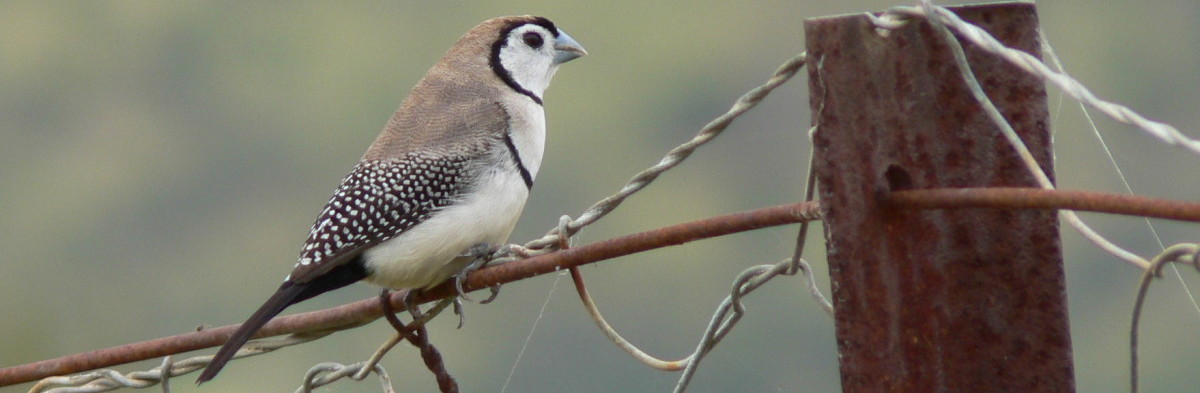
- Double-barred Finch Taeniopygia bichenovii 2 (1.16%)
- House Sparrow Passer domesticus 3 (1.74%)
- Australasian Pipit Anthus novaeseelandiae 4 (2.33%)
- Golden-headed Cisticola Cisticola exilis 1 (0.58%)
- Brown Songlark Cincloramphus cruralis 2 (1.16%)
- Rufous Songlark Cincloramphus mathewsi 13 (7.56%)
- Little Grassbird Poodytes gramineus 1 (0.58%)
- Australian Reed-Warbler Acrocephalus australis 4 (2.33%)
- Fairy Martin Petrochelidon ariel 14 (8.14%) (B)
- Tree Martin Petrochelidon nigricans 2 (1.16%)
- Welcome Swallow Hirundo neoxena 16 (9.30%)
- Silvereye Zosterops lateralis 2 (1.16%)
- Common Starling Sturnus vulgaris 3 (1.74%)
- Common Myna Acridotheres tristis 7 (4.07%)
- Common Blackbird Turdus merula 1 (0.58%)
- Domestic Duck 1 (0.58%)